Built from public filings and market data. Returns and valuations are the output of my own assumptions.
Project Zenith · LBO model · Personal project, 2026
Zendesk take-private: LBO model and investment memo, $10.2bn
$10.2bn
Deal value, Hellman & Friedman and Permira, 2022
6.2x
Revenue multiple paid; the EBITDA multiple is not meaningful
c.13%
IRR on my base case, 1.8x over five years
c.$64
Share price a 20% IRR supports, against $77.50 paid
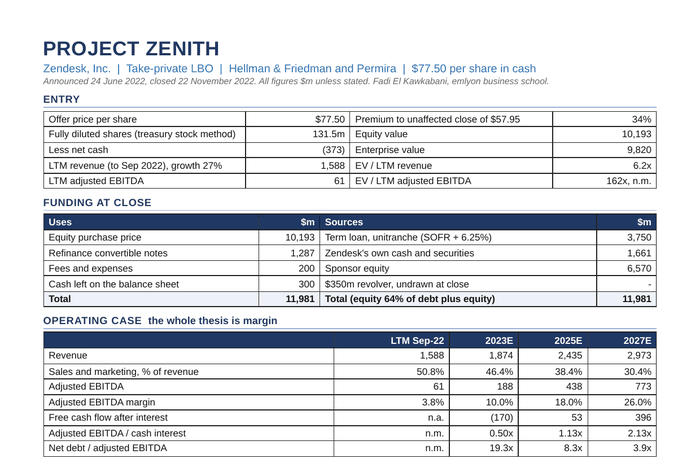
(opens in a new tab)The top of the one-page tear sheet: entry valuation, funding at close and the operating case.
In 2022 Hellman & Friedman and Permira took Zendesk private for $10.2bn. I rebuilt the deal from the SEC filings and the merger proxy: the funding at close, an operating case, a debt schedule with a cash sweep and a revolver, a DCF and trading comparables. On my base case the deal returns 1.8x and about 13% over five years, below what a fund of that size would target. Rather than tune the assumptions until the answer looked better, I worked out what price a 20% return would support, and set out why the gap exists.
Method
LTM adjusted EBITDA. Treasury stock method and the equity to enterprise value bridge. Sources and uses. An operating case with deferred revenue in working capital. A debt schedule with revolver and cash sweep. Returns, with sensitivity tables on the exit multiple and entry price. DCF and trading comparables.
Finding
The widely quoted $10.2bn is equity value, not enterprise value: Zendesk held more cash than debt. At 162x LTM adjusted EBITDA the deal cannot be discussed in EBITDA multiples at all, so entry is measured on revenue, which is what the buyers did.
Build
8 tabs and 866 live formulas. Every input carries its source or its reasoning beside it, and every check row passes. Market data from the NY Fed, the US Treasury and Damodaran.
Project Meridian · M&A model · Personal project, 2026
PepsiCo / Celsius: hypothetical $11bn M&A model
27.3%
Premium: a $42.00 offer against a $32.98 unaffected price
18.8x
EV / 2025 adjusted EBITDA, against an 18.0x peer median
1.4x
Synergy value against the premium paid; 0.6x on cost savings alone
+3.4%
EPS accretion in year 3, neutral in year 1
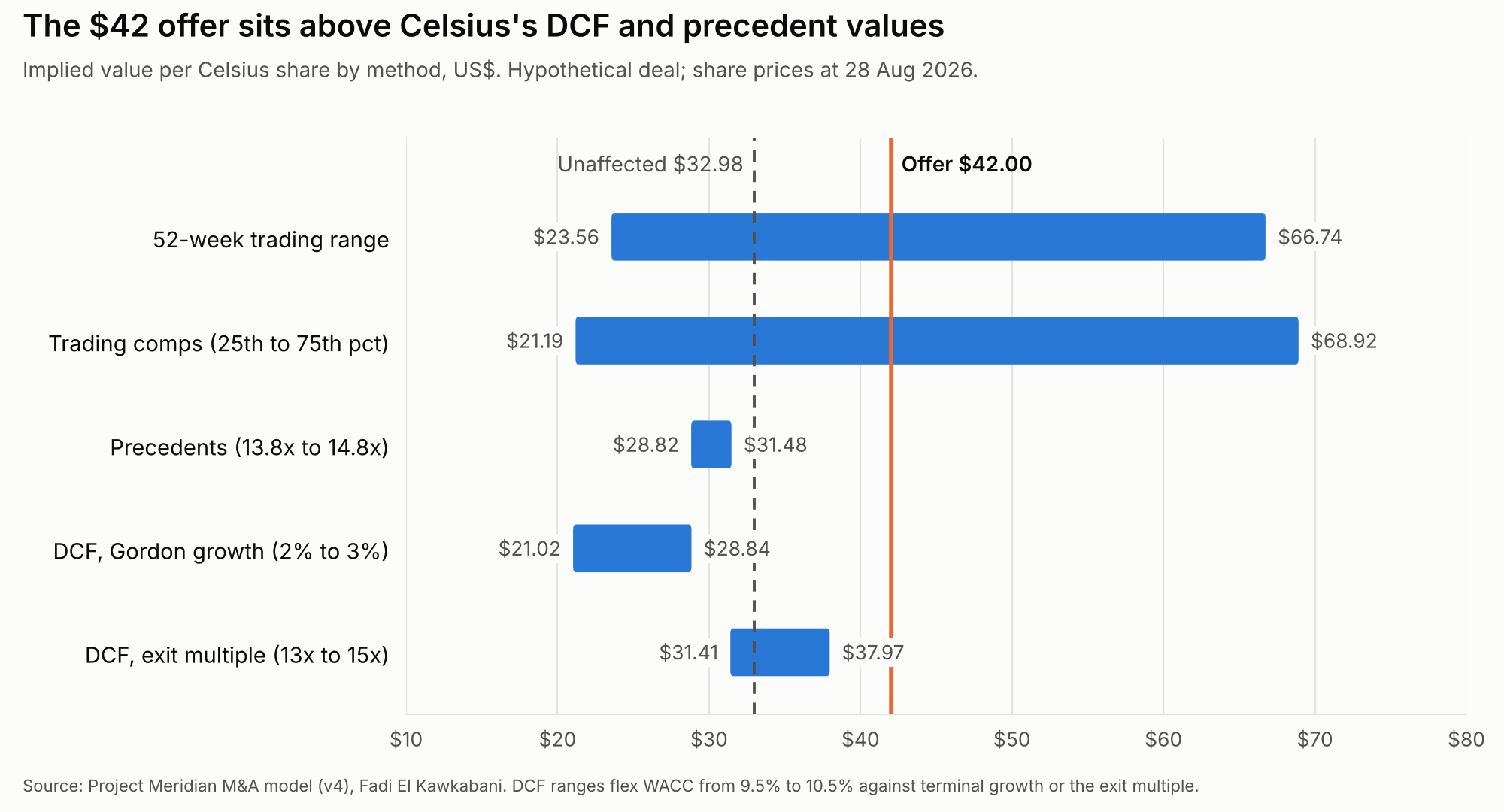
(opens in a new tab)Football field: implied value per Celsius share by method, against the $42.00 offer and the $32.98 unaffected price.
A hypothetical acquisition of Celsius Holdings by PepsiCo. Two linked three-statement models, one per company, run from 2023 actuals to 2030, balance in every year with no plug, and tie to the 10-K filings. Celsius is valued three ways: a DCF at a 10.0% WACC, trading comparables from Capital IQ, and precedent transactions. The deal sits on top: an offer of $42.00 a share, a 27.3% premium, paid 75% in cash and 25% in PepsiCo stock. EPS is neutral in the first year and accretive from the second.
Method
Linked three-statement models and business plans to 2030 for both companies. DCF at a 10.0% WACC, with both terminal value methods cross-checked. Capital IQ trading comparables and precedent transactions. Sources and uses, purchase price allocation with the deferred tax on the step-up, phased synergies, EPS accretion and dilution with sensitivities, and the credit impact.
Finding
PepsiCo already owns all of Celsius’s convertible preferred stock, $1.76bn at carrying value. The deal therefore buys only the common shares: the preferred stays in enterprise value for the multiples, and on consolidation it disappears with its dividends. The value test matters more than accretion: synergies cover the premium 1.4 times, but only 0.6 times on cost savings alone, so the case rests on revenue growth.
Build
10 tabs, 9 integrity checks all passing, no plug and no circular references. Every headline output was recomputed independently from the inputs and matched.
Hypothetical transaction, built for analysis. Not a live or advised deal.
Experience
Consulting in Geneva, alongside a venture capital fund
ETLYON, Geneva, Switzerland
Apr 2026 to Sep 2026
Financial & IT Consulting Intern · reporting directly to the principal, co-owner of a venture capital fund
Reorganised the data room into 10 sections and connected an AI assistant to search and cross-check it.
Co-prepared the fund’s semi-annual LP report with its accountant: NAV for 5 CHF/EUR share classes and TVPI.
Helped model a portfolio company’s fully diluted cap table: 40+ holders, 3 share classes and 3 equity plans.
Reviewed a startup’s financial model and fixed 4 errors (broken links, hard-coded inputs).
Produced a counterparty due diligence pack (go/no-go gates, scoring model) for a precious metals refiner.
Nadim Khoury Physio Center, Lebanon
Jun 2024 to Jul 2024
Accounting Intern
Booked journal entries, reconciled supplier invoices against bank statements, and maintained accounts payable and weekly cash flow files for a medical practice.
Education
emlyon MSc Finance. Sorbonne computer science.
emlyon business school, Lyon, France
Oct 2025 to Apr 2027
MSc in Finance, Corporate Finance track · Target GPA: 3.8/4.0
Coursework: financial modelling, corporate valuation, financial analysis, mergers and acquisitions, financial due diligence and quality of earnings, leveraged finance, advanced accounting (IFRS and French GAAP).
Sorbonne Université, Paris, France
Sep 2022 to May 2025
Licence en Informatique (BSc Computer Science), Management minor · GPA: 3.5/4.0
Algorithms, data structures, databases, Python and statistics, with accounting, economics and management through the minor.
Bloomberg Market Concepts (BMC) and Finance Fundamentals (BFF)
Languages
Trilingual, native in French, English and Arabic
Interests
Weight training (5 years), basketball, running and sport fishing
About
Computer science first, then finance
I read computer science at Sorbonne Université before moving to finance at emlyon, where I am now in the final year of the MSc in Finance, Corporate Finance track. Three years of algorithms, data structures and databases came first, then valuation, modelling and financial analysis.
That order matters. It is why I would rather build a model from a blank sheet than start from someone else’s, and why I check whether the data underneath an analysis can be trusted before I use it.
From April to September 2026 I was a financial and IT consulting intern at ETLYON in Geneva, reporting directly to the principal, who co-owns a venture capital fund. The work ran from the fund’s LP report and a portfolio company’s cap table to model reviews and due diligence.
I finish at emlyon at the end of April 2027. I work in French, English and Arabic.
 (opens in a new tab)